Signs of the Times: So This Is Why I Spent Four Years in Korea
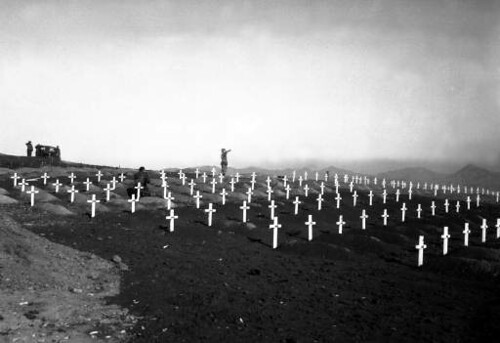
Above: 1950. A Marine plays taps over the graves of just a few of the 33,629 Americans killed in action in Korea.
Below: August 2005. South Korean demonstrators show their appreciation for their prosperity and freedom of speech by standing at the entrance to a soccer match holding signs that say, “American soldiers not admitted.” The U.S. team was not playing.
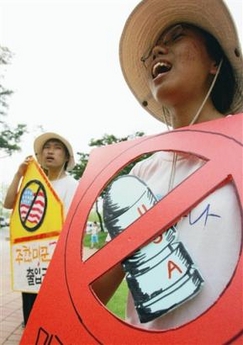
Isolated incident? No.
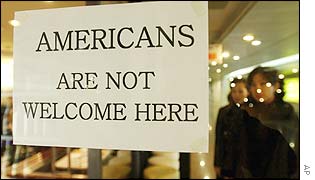
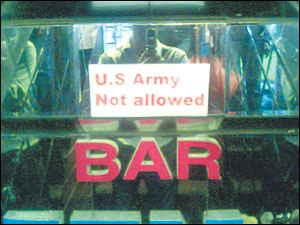
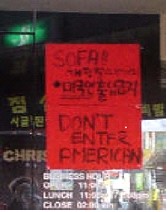
Barring American soldiers from Korean businesses is quite common, as I can attest from personal experience, but permitting discrimination at a public event is a new low. Does Congress know about this? Why does the South Korean government allow this?
More here and here. Despite the sacrifice of tens of thousands of American lives and billions of dollars, the United States and Korea share relatively few common values or interests today except for a mutual desire for trade, which doesn’t require a U.S. military presence. There is no longer a strategic, diplomatic, or political justification for keeping U.S. ground troops in South Korea, where they are tempting targets for North Korean artillery, missiles, and terror attacks. Our soldiers in Korea today are essentially nuclear hostages to Kim Jong Il. Their presence constrains our strategic flexibility in dealing with North Korea. And while the South Koreans generally want our troops to stay, their reasons are primarily financial. Surveys also show the presence of deep-seated anti-Americanism among a majority of Koreans (for example, 58% of Koreans were disappointed that the Iraqi army did not resist more in defending Baghdad).
It’s time for Korea to defend itself. Write Congress. It’s working.
Thanks to the reader who forwarded this. Readers serving in South Korea are cordially invited to carry their digital cameras and send more. Other bloggers, please pass the word along: we can bring attention to repugnant and racist anti-Americanism that’s directed toward our service members and attach political consequences to it.
This, too, is a way you can support our troops.
Update:

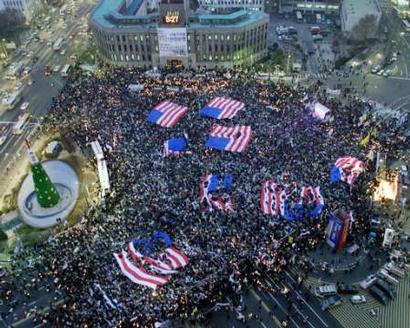
This is from late 2002 or early 2003–a demonstration at Seoul City Hall in which thousands of protestors tore up giant U.S. flags. This wave of demonstrations followed the acquittal of two U.S. Army sergeants who ran over two Korean schoolgirls during an exercise (read more here about how the accident continues to haunt one of them, even after he left the Army). All evidence suggests that the deaths, no matter how tragic, were accidental, but the “Korean Street”–shunning generous compensation and numerous apologies from the President and U.S. generals–demanded that the soldiers be tried in Korean courts. I can only speculate as to whether that trial would have been fair, but having served for four years as an Army judge advocate in Korea, and having reviewed numerous Korean investigation reports and trial results, I do speculate that the proceedings would have been politicized and lacking in basic procedural guarantees of fairness. The fact that one of the Army defense attorneys, a friend of mine, could not leave Camp Casey for months after the acquittal, gives an idea of the political climate.
Just for perspective, there is nothing approaching this level of public outrage over the deaths of 2-3 million North Koreans, in spite of evidence that their deaths were not only preventable, but very possibly intentional.
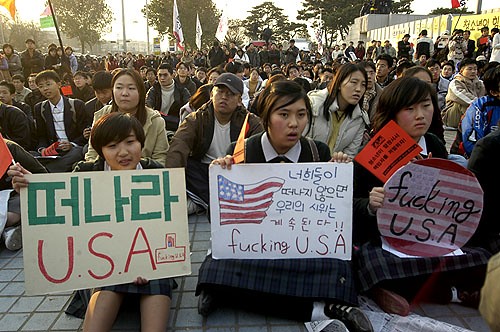
Below: July or August 2005. Korean police prevent demonstrators from tearing down a statute of General MacArthur at Incheon, site of MacArthur’s famous landing that (at least temporarily) changed the course of the Korean War. Background here. The demonstrators intend to return in force on August 15th, the anniversary of Korea’s liberation from Japan, for another try. Although “8/15” has become a nationalist rallying cry, Koreans tend to overlook or minimize the fact that it was the U.S. Army that liberated Korea on 8/15.
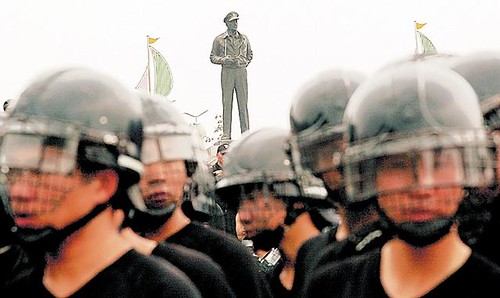
If this statue comes down on 8/15, I’m prepared to predict that the video that will run on American television screens will cause an unprecedented backlash in U.S. public opinion, and will irretrieveably undermine public support that would be required for the U.S. to intervene in a conflict on Korea’s behalf.
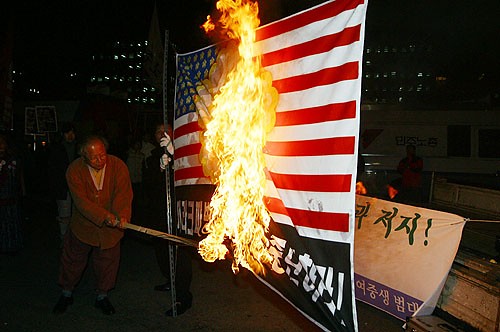
Afterthought: Lest anyone misunderstand my message, I consider flag-burning to be the kind of political speech that should be lawful and protected, even if I also consider it an immature and repugnant way of expressing one’s views. That’s still true in spite of the added irony in the context of Korea, which owes so much of its easy, decadent, and free life to American sacrifices.
What should never be legitimized or tolerated is discrimination or racially/politically motivated violence. The problem is that the South Korean government does tolerate it. The specific demand must be this: if you expect American soldiers to protect your rights with their blood, you must protect their rights with your laws.
Update 2: Reader “Slim” reminds me that the South Korean Ambassador, who will soon depart prematurely after his implication in a campaign-finance scandal, recently took on the “misconception” that “anti-Americanism is rife in Korea.” Here is a link to the South Korean embassy, and here is a link to South Korea’s Human Rights Commission. The HRC, which is mainly famous for enforcing the rights of middle school students to wear long hair and keep their diaries private, has just begun to broach the subject of racial discrimination against mixed-race Koreans (but has shown little serious interest in the human rights of North Koreans).
Please, politely ask that the Korean government do what it took our own government far too long to do: outlaw discrimination based on race or national origin in public accomodations, and consider creating a private legal right to sue for damages in such an event.
28 Responses
-
Pingback: The Korea Liberator » Yongsan Fire Pics
-
Pingback: The Korea Liberator » Some Perspective
-
Pingback: OneFreeKorea » Korean Apartheid Watch
-
Pingback: OneFreeKorea » Almost Right
-
Pingback: OneFreeKorea » Here Comes the Election!
-
Pingback: OneFreeKorea » Links for 12 Oct 07
-
Pingback: OneFreeKorea » Henry Hyde, R.I.P.
koreans are so racist it’s sickening. HAH! Now you know how minorities in the US feel you motherf’ing crackers, how does it feel to have a taste of your own medicine. Asian Americans have been oppressed since the 1850’s, don’t I haven’t forgotten about the Chinese Exclusion Act and the Japanese Concentration Camps you f’ing piece of sh*ts.
You have to get one of these every now and then.
Bite….bite back….bite…..bite back. There is such a thing as counter-racism as John Le illustrated perfectly.
Unfortunately American soldiers have not always been the best ambassadors for the US …. a lot of bars and service businesses ban them because soldiers become unruly and scrappy while drinking there. I dont think its fair to tarnish all South Koreans as “ungrateful anti-americans” just like I dont think its fair to tarnish all american soldiers as brutish drunken thugs. Most south koreans that I know view the US as their ally and economic trading partner. Dont judge south koreans by a small percentage of their population who express otherwise. And the idea that south koreans are anti-american because of influence from the north is just ridiculous!!!!!!!!!!!
Your argument is interesting and I can understand why you believe what you believe. However, as a person with a doctorate in International Relations, I would like to make one point: our government spends trillions of dollars to keep troops overseas mostly to protect our own self-interest. If you actually examine inter-government contracts, and study American policy on international relations, it’s quite clear. Korea does NOT want the US presence and it’s made that clear since the early 2000. Korea does NOT actually gain financially from the US protection. It has spent trillions of dollars to clean up the mess and repair environmental damage created by the US troops. Also, the US forces Korea to pay 50% of the cost of keeping US troops in Korea. However, the US insists on keeping the troops there for basically one big reason: South Korea is America’s only strategic military outpost in East Asia. Other east asian countries won’t allow or has already kicked US out of their countries. Think about it, would China, North Korea, Russia, or Japan allow US to stay in their countries? But the US needs to keep their troops in East Asia because countries such as China, North Korea, and to some extent Russia, pose a threat against the United States.
Sorry, “Dr” Cathy, there are more US troops in Japan than in Korea — almost twice as many.
Maybe “Dr.” Cathy can explain why successive Korean governments controlled by competing political parties have defied the will of the people who elected them and continue to allow the USFK to trash the environment and shake down the government for money.